Local development, in a window
A local development environment that is a desktop app
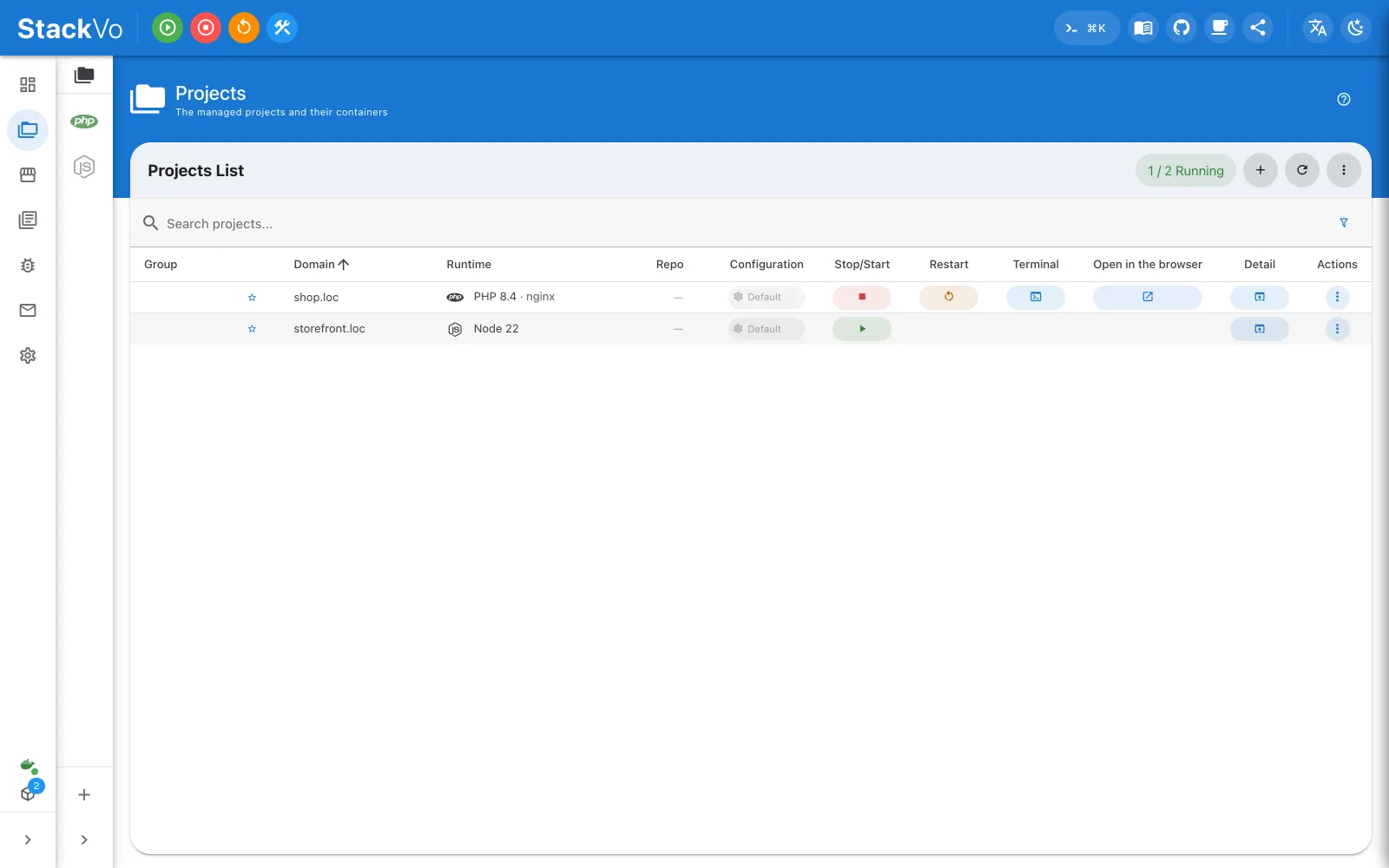
One Docker container per project, with its own runtime version, its own database and its own domain — https://shop.loc, trusted certificate included. PHP, Node, Python, Go, Ruby or Rust. StackVo runs on your host, not inside a container, so it opens even when Docker is down.
A complete local stack
Runtimes, web servers, databases and tools, installed as instances and picked per project. Laravel, Symfony, WordPress and Next.js get presets; anything else is a folder with a runtime.
Runtimes
- PHP 5.6–8.5
- Node.js
- Python
- Go
- Ruby
- Rust
Web servers
- nginx
- Apache
- Caddy
- FrankenPHP
- Swoole
- RoadRunner
Databases
- MySQL
- MariaDB
- PostgreSQL
- MongoDB
- ClickHouse
- Cassandra
- MS SQL Server
Cache and messaging
- Redis
- Valkey
- Memcached
- Dragonfly
- RabbitMQ
- Kafka
Tools
- Mailpit
- phpMyAdmin
- Adminer
- pgAdmin
- Grafana
- MinIO
Also search, monitoring, queues and admin UIs — and more than 80 PHP extensions.
What the others do not
Every tool in this category gives you PHP, a database and a domain. These are the things you get here and nowhere else.
A full environment per git branch
Each worktree gets its own hostname and its own database. Preview environments, locally and free.
Why was this request slow?
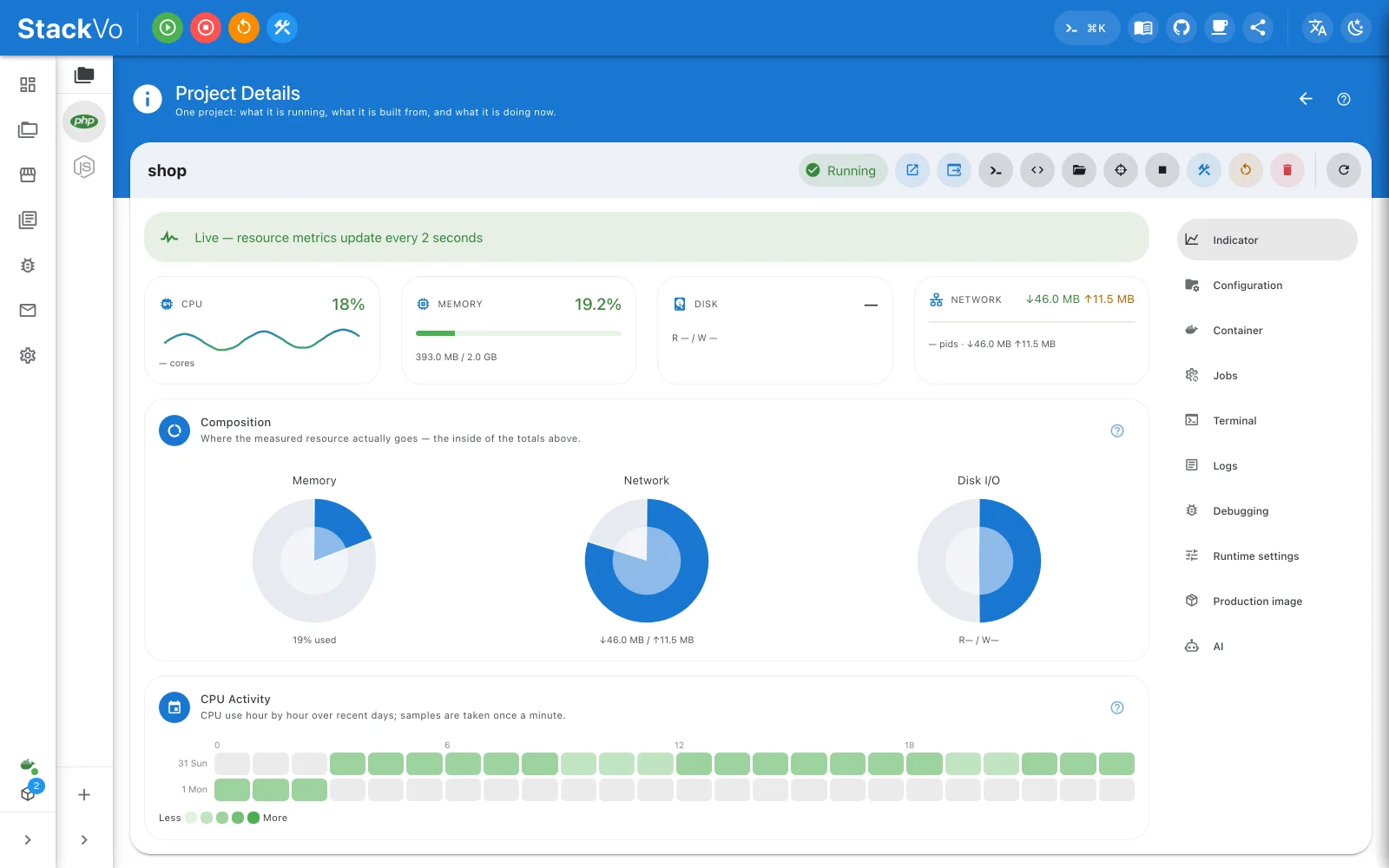
Profiler, query log and your dump() calls on one axis; replay a recorded request with one click.
One container per project
PHP 5.6–8.5, Node, Python, Go, Ruby, Rust — what runs is what a Dockerfile says, not what your brew history says.
MCP for AI assistants, with a leash
38 tools. Writes sit behind an explicit flag, a project scope and a time limit.
Builds the production image
The same manifest renders the image you ship, and exports a devcontainer for the cloud.
Measures what Docker costs you
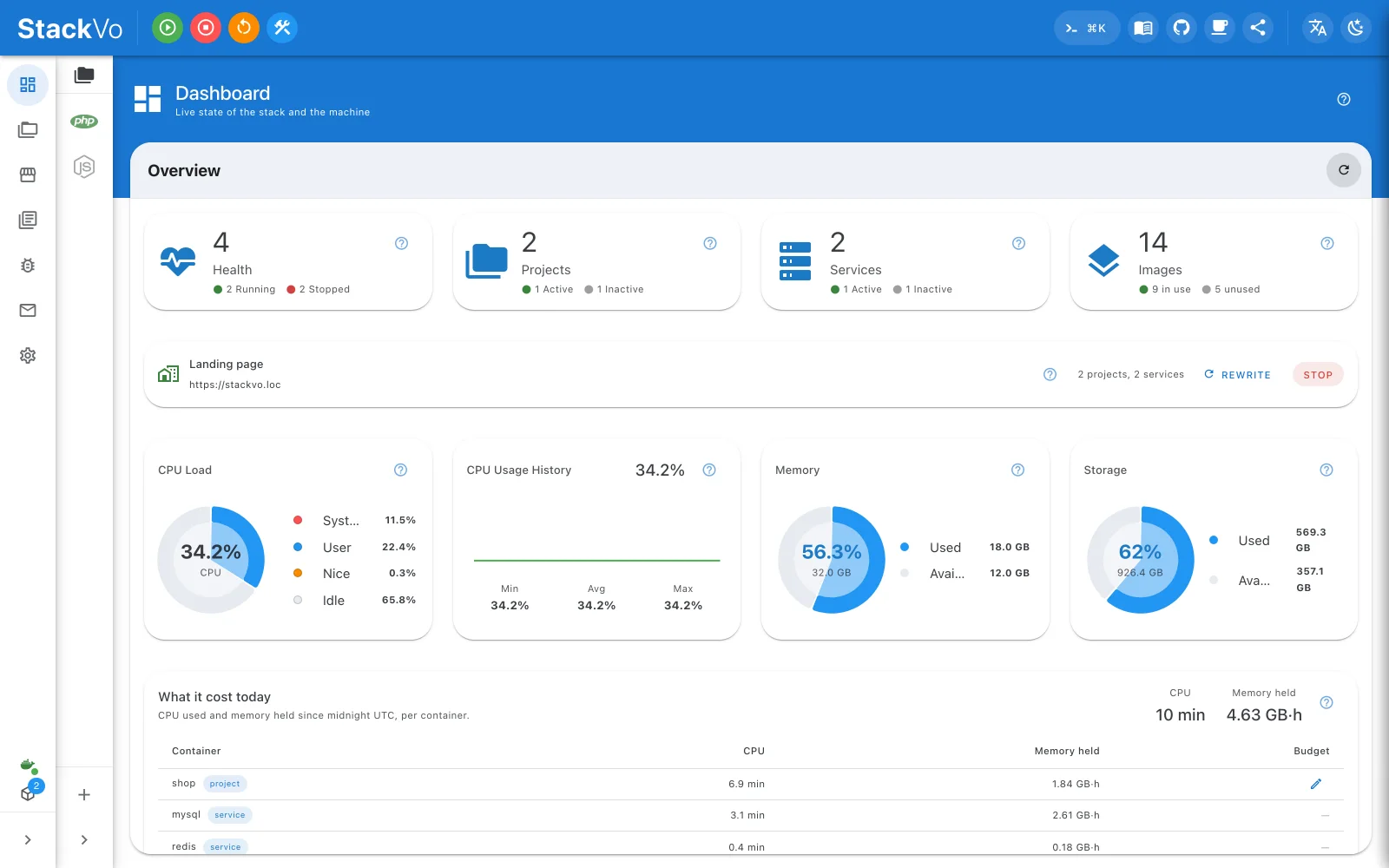
"shop has held 4.2 GB·hours and used 38 minutes of CPU today." The only tool here that says so.
Download
Ten installers per release, every platform and both CPU families. Not code-signed by decision; every release publishes SHA256 checksums and the updater verifies a minisign signature.
Three steps to a running project
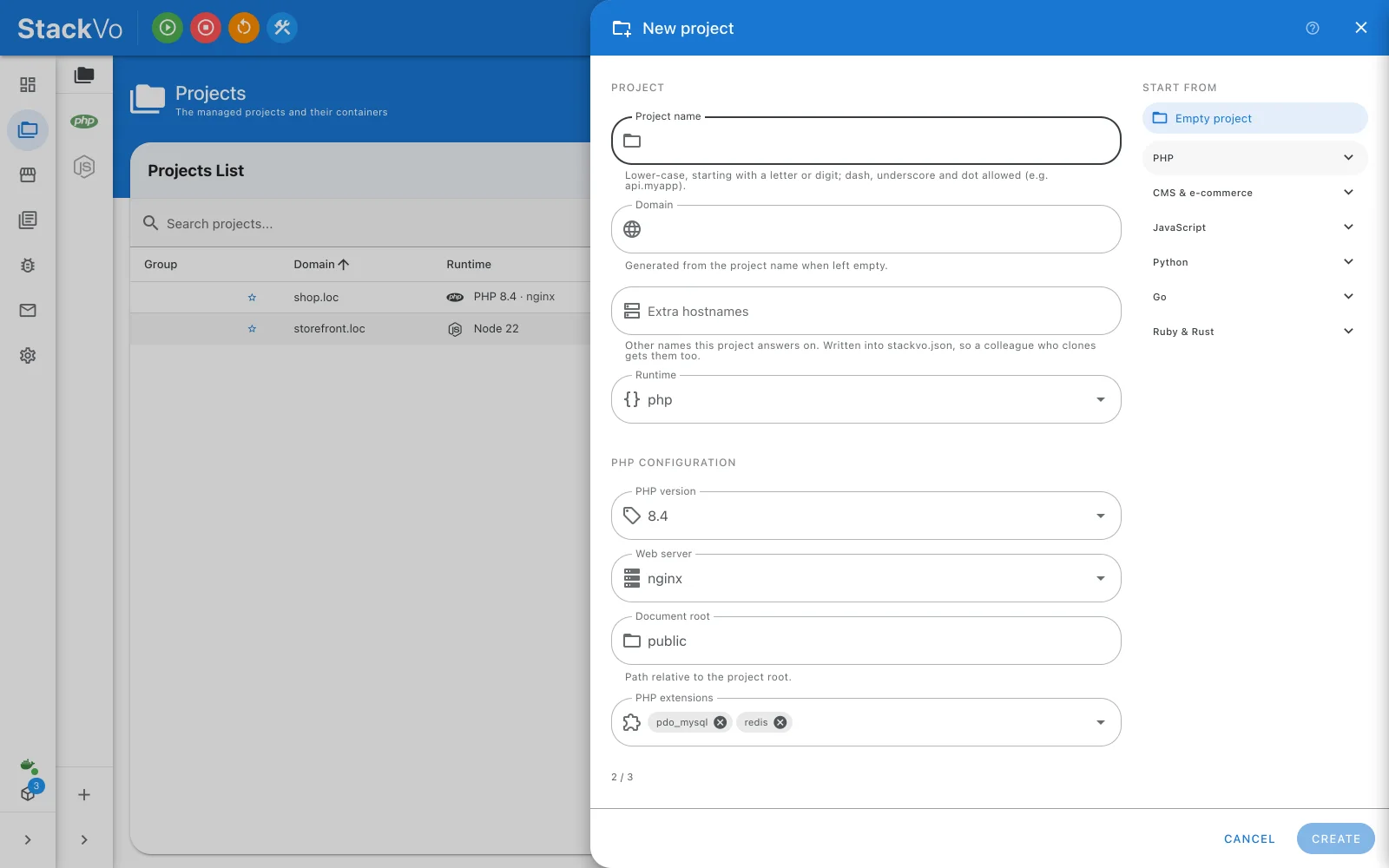
No terminal, no config file, no Docker knowledge. The window asks, you answer.
-
Pick a folder for the workspace
The first launch asks exactly one question. An empty folder is enough; the app writes the rest.
-
Name the project, choose the stack
Laravel, WordPress, Symfony, plain PHP, Node… then the runtime version, the web server and the services.
-
Press Create
The build streams Docker's own output. When it finishes, the domain opens in your browser with no certificate warning.
How it compares
What each tool chose, not which is better. Compiled from each project's own documentation.
| StackVo | Herd | ServBay | Laragon | DDEV | FlyEnv | |
|---|---|---|---|---|---|---|
| Approach | Docker + desktop | Native binaries | Native binaries | Native binaries | Docker + CLI | Native binaries |
| Platforms | mac · Win · Linux | mac · Win | mac · Win | Win | mac · Win · Linux | mac · Win · Linux |
| Project isolation | Container | Site | Site | Site | Container | Site |
| Per-branch env with its own DB | Yes | No | No | No | partial | No |
| Request-level "why slow" | Yes | (Pro)partial | No | No | No | No |
| Replay a recorded request | Yes | No | No | No | No | No |
| In-app mail inbox | Yes | Pro | Pro | Yes | web UI | Yes |
| Named DB snapshots | + scheduledYes | No | scheduled | scheduled | Yes | No |
| MCP for AI assistants | 38 tools scoped | No | Yes | No | No | Yes |
| Builds the production image | Yes | No | No | No | No | No |
| Import sources | 7 | 1 | a few | No | a few | a few |
| Price | Free, MIT | Free + Pro $99/yr | Free + Pro | Free | Free, Apache-2 | Free + Pro $10 |
- Yes
- partial
- No
Pricing
$0forever
Everything, for everyone
There is no Pro tier and there is not going to be one. Nothing is gated behind an account, a licence key or a nag screen.
- Every feature, on every platform
- No account, no licence key, no telemetry
- MIT-licensed — the code stays available whatever happens
- Updates verified with a minisign signature
What that means, plainly
- Maintained by one person Issues are read and most get answered. "Most" is the honest word; there is no response-time commitment.
- Not funded No company, no foundation, no sponsorship behind it today. Several tools in this category have one; this one does not.
- No support contract The MIT licence means the code stays available whatever happens. It does not mean somebody will be there to fix it.
Commonly asked questions
Short answers. The longer ones are in the documentation and in the README.
Something else? Ask in Discussions
Is it really free?
Yes. Free, MIT-licensed, every feature on every platform. No paid tier, no account, no telemetry.
Is it only for Laravel?
No. Laravel, Symfony and WordPress get presets, but a project is any folder with a runtime: PHP, Node, Python, Go, Ruby or Rust.
Is Docker required?
Yes: Docker Desktop, Docker Engine, or Podman, Colima or OrbStack. If it is not running, the app opens, says so and offers to start it.
Why isn't it code-signed?
Certificates are recurring costs with an identity attached. Instead every release publishes SHA256 checksums and the updater verifies a minisign signature.
Can I run two versions of the same service at once?
Yes. Services are instances: MySQL 8.0 and 8.4 side by side, each project on the one it asked for.
What does Docker cost me compared with a native tool?
An install that includes Docker, an image build on a project's first start, and the VM's idle memory. In return, what runs is what a Dockerfile says.
What is the state of Windows support?
Windows is in the CI matrix and the suite passes there; the hosts write through UAC and the named pipe against Docker Desktop are still unverified on a real machine.
Where does my data go?
Nowhere. No telemetry. The network calls are the ones you press, plus one help document fetched from the repository when you open a help panel.
And then
The rest of what the window does, each with its own page.
Mail, dumps and logs in the window
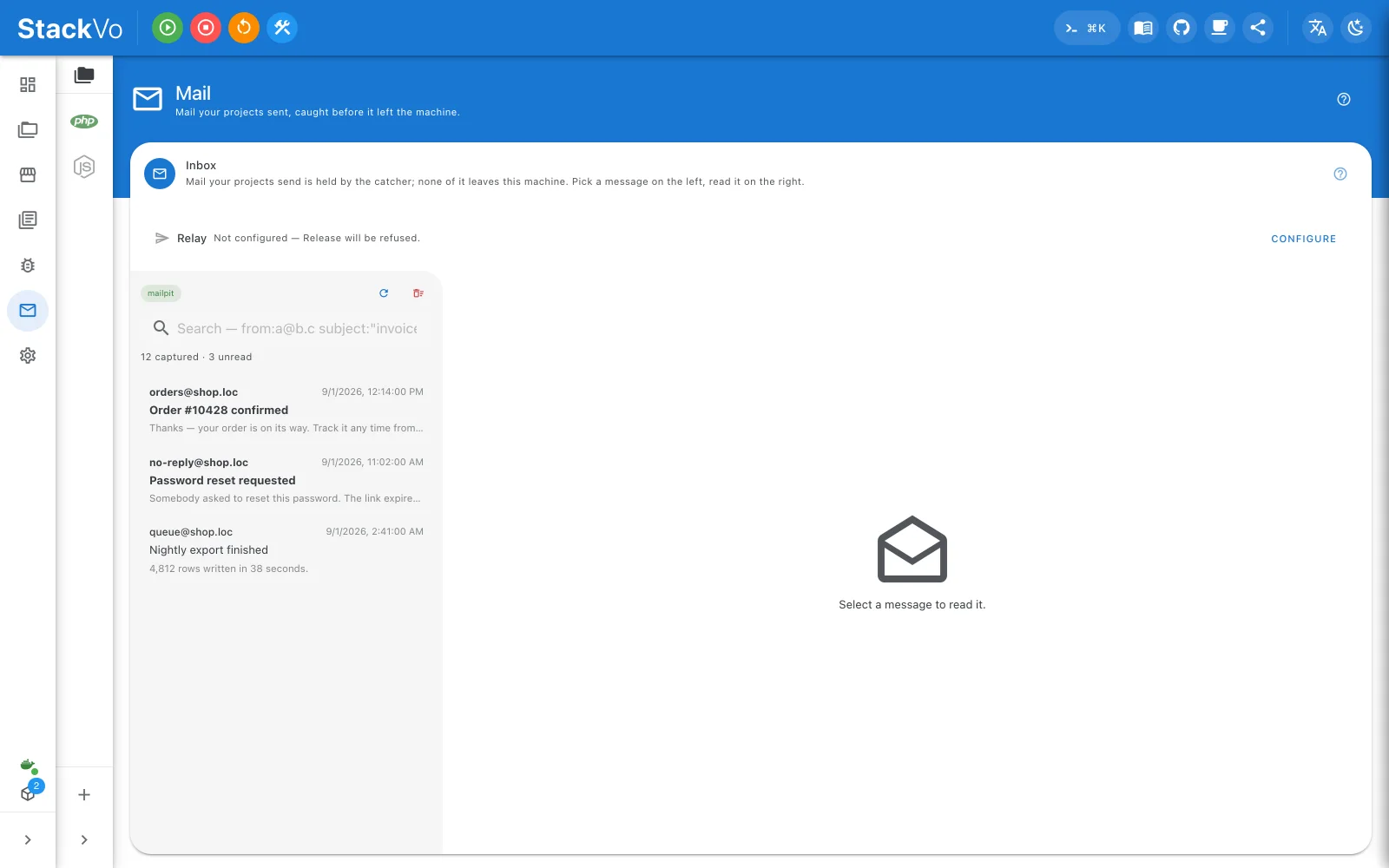
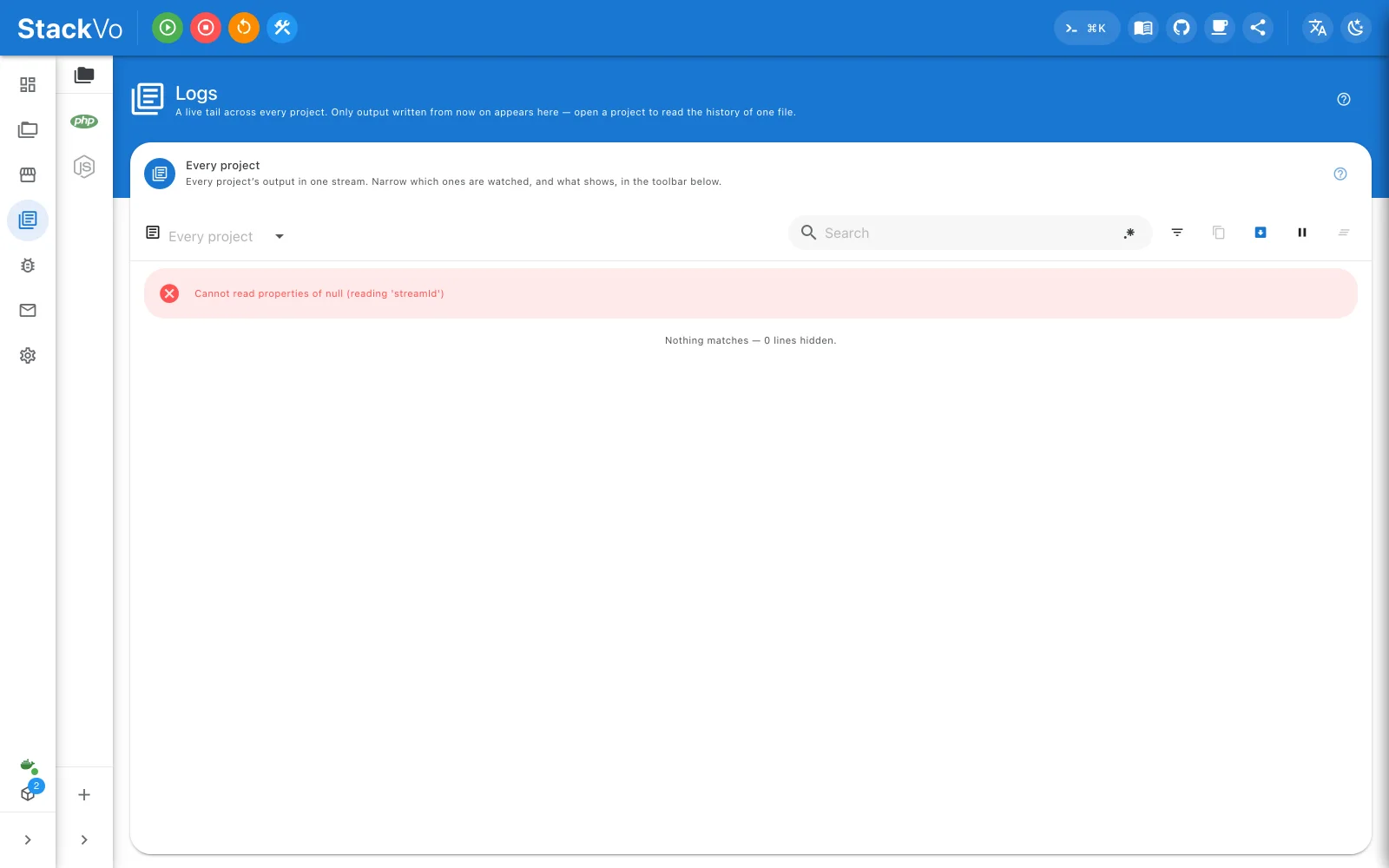
Sent mail is captured, dump() output is collected, every project's logs are live in one place.
Named database snapshots
Take one before a migration and restore it by name. Scheduled snapshots too.
Public tunnels, eight providers
Cloudflare, ngrok, Tailscale, zrok, Pinggy, localtunnel, localhost.run, LocalXpose.
Imports from seven tools
XAMPP, Laragon, MAMP, Valet, Sail, Herd, DDEV — it brings your projects over.
Doctor
Says what is broken and how to fix it, line by line, with a button beside most findings.
A terminal and a TUI too
Everything the window does has a stackvo command; the CLI is there for scripts and CI.
Sponsorship
Become a sponsor
StackVo is free, MIT-licensed and maintained by one person, with no company behind it and no paid tier. If it saves you time, sponsoring is what keeps it maintained — and what turns "most issues get answered" into "issues get answered".