Services and databases
MySQL, Redis, Elasticsearch and the rest come from a catalogue, are installed as instances, and are switched on per project. Three acts, three places.
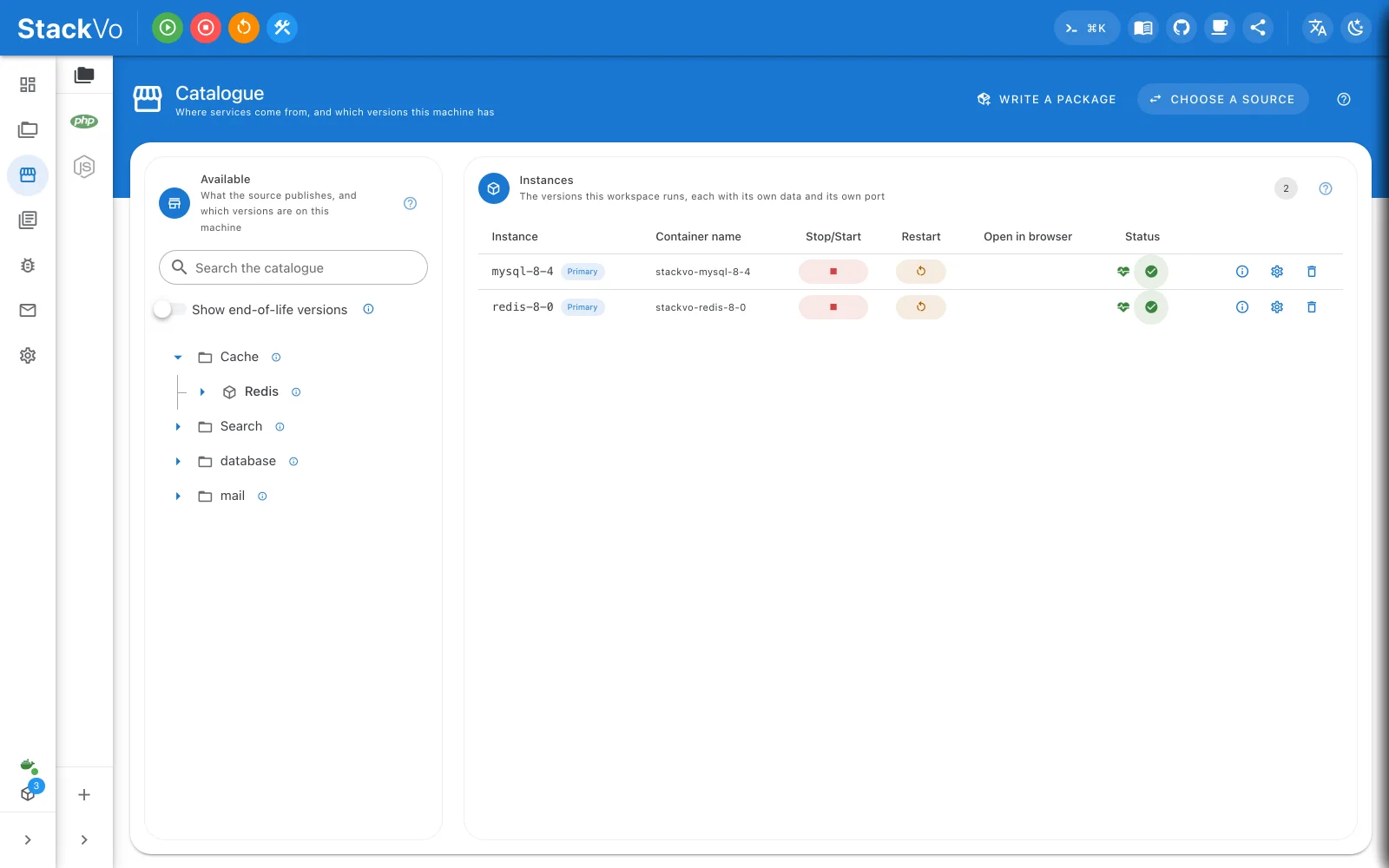
1. Install from the catalogue
Catalogue → Available lists what a source publishes, with versions. Install puts the package on disk. Nothing runs yet.
StackVo carries no services inside itself; until a source is given nothing is available. The catalogue is signed — the registry with minisign, each package with a checksum — and an unsigned source is named as such.
2. Add an instance
Catalogue → Service instances → Add starts that version in this workspace. Each instance has its own data and its own port.
The moment to set the root password is now: an image reads it only when it first initialises an empty data directory. After that, the password is what it is.
Two versions of one service run side by side — MySQL 8.0 and 8.4 — and each keeps its own data. Make primary sets the default for projects that name no instance.
3. Switch it on for a project
Project → Services lists what the project declares and what this machine runs:
| State | What it means |
|---|---|
| On here | Running, and the project can reach it. |
| Not on here | The project wants it and this machine does not run it. Enable starts it. |
| Suggested | A guess read from the project's own .env — DB_CONNECTION=pgsql, say. Never written on its own; Write to stackvo.json turns it into a declaration you commit. |
The connection string sits in the same pane. The password appears on a click.
Two versions at once
Project A on MySQL 8.0, project B on 8.4, both running: services are instances, not one global copy. Each project connects to the one it asked for.
Removing
Remove on an instance deletes its data with it. Take a snapshot first if you want to keep it.