Sharing and teams
Four ways out of your machine, for four different needs.
A public URL
Project → Share → Get a public URL. A tunnel client runs as a sidecar
container and dials out; no port is opened on this machine. For webhook
senders and other outside services that cannot reach a .loc domain.
Nine providers: Cloudflare (anonymous and named), ngrok, Tailscale, zrok, Pinggy, localtunnel, localhost.run, LocalXpose.
| Kind | Address | Account |
|---|---|---|
| Anonymous quick tunnel | Changes on every start | Not needed |
| A provider that keeps an address | Stays the same | Needed; the token goes into the OS keystore |
Ask for a password puts basic authentication in front of the link. Stop takes the sidecar down and the address stops working immediately.
A phone on the same Wi-Fi
Project → On this network — a name other devices can resolve, nothing leaving the network, one certificate warning to accept on the phone. See Domains and HTTPS.
The same stack for a colleague
stackvo.json says which services. It cannot say which versions,
because those live in .env — the one file nobody commits. That half is a
preset: stackvo.preset.json, beside the manifest, in the repository.
{
  "services": { "mysql": { "enabled": true, "version": "8.4" },
                "redis": { "enabled": true, "version": "7.2" } },
  "settings": { "DEFAULT_TLD_SUFFIX": "loc" }
}
Export one from Settings → Workspace. A colleague clones, opens the project, and the Services card says a preset is there and shows the plan first — a file that arrived with somebody else's clone must not rewrite a stack because a page was opened. A preset can never carry a secret; the schema has nowhere to put one.
Someone without StackVo
Project → Devcontainer → Write files into the project puts a .devcontainer/ into the
project, so a colleague can open the repository in VS Code or GitHub
Codespaces and get the same container: the same PHP version, extensions and
web server, the same services at the same versions. Passwords leave as
names read from a gitignored .devcontainer/.env. The files are meant to be
committed, and are rewritten from the manifest every time.
The image you ship
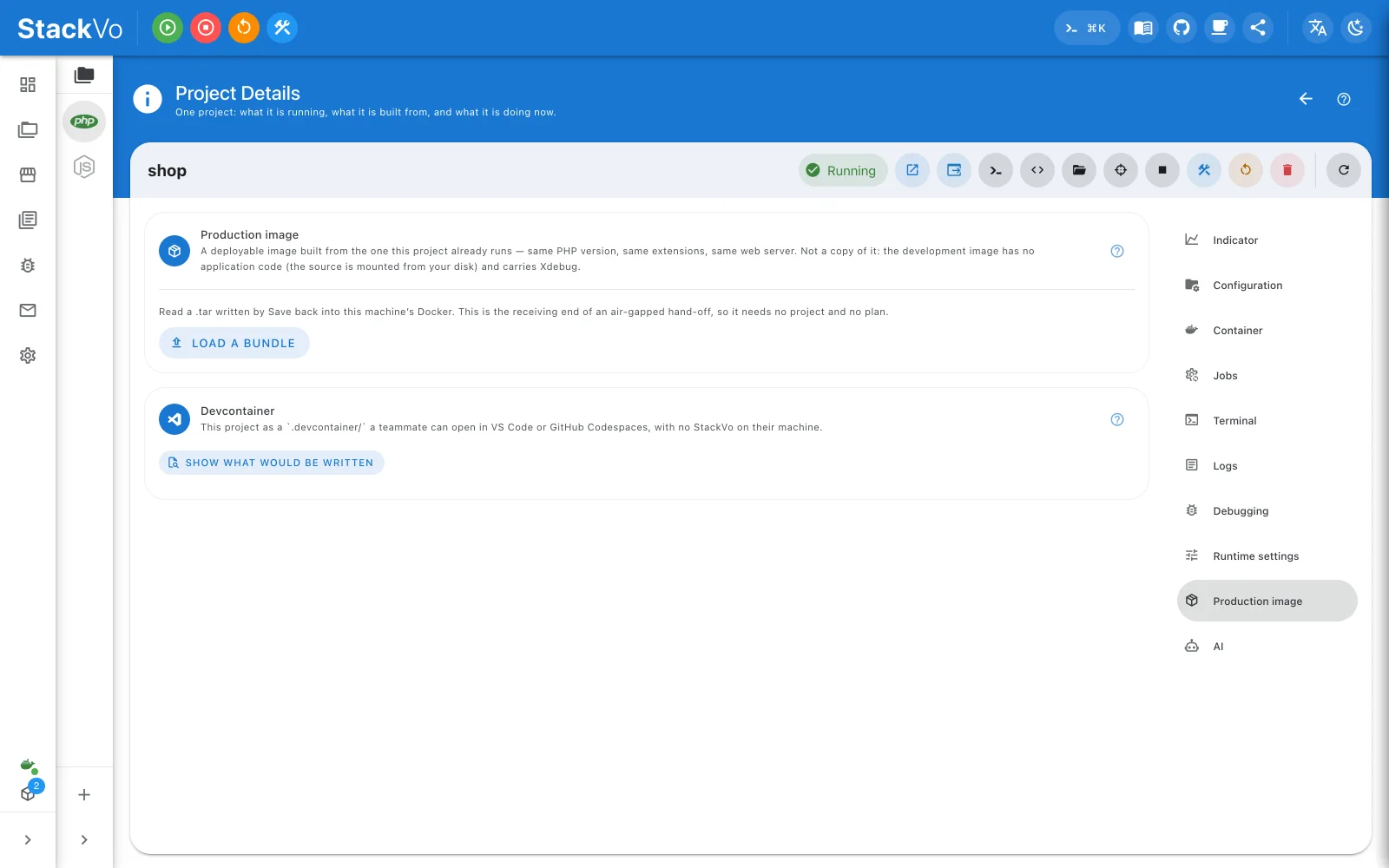
Project → Production image builds a shippable image from the one the project already runs — same PHP, same extensions, same web server, with your code inside and Xdebug out. Check verifies it, Push sends it to a registry, Deployment recipe gives you a compose file that runs it. Only a verified image is pushed, and only to a tag carrying a registry name.